
Fair Lawn Previous Residents by Era
Past residents leave different kinds of traces at different times. For a recent Fair Lawn address, begin with the county recording index and the parcel identifiers that point to a document. For a mid-century household, the Heritage Center's directory microfilm and federal census schedules can add context. Older property work moves to the County Clerk's records division and its earlier books or indexes. A map or printed listing is evidence for a specific question, not a shortcut around the recorded document trail.
| Source | Years it covers | Where held | What it can show |
|---|---|---|---|
| Bergen land-record search | January 1, 1970 to present | Bergen County Clerk online | Recorded parties, type, recording date, book/page, and legal identifiers |
| Older land books and indexes | Before the online window | County Clerk records division | Earlier document references and copies after an index search |
| Heritage Center directories | Fair Lawn material, 1931 to 1973 | Ridgewood Public Library Reference microfilm | Listed occupants, businesses, street wording, and address leads |
| Federal census | Public schedules through 1950 | Federal and library research collections | Household context, relationship, age, and enumeration geography |
| Fair Lawn Sanborn sheets | 1948 to 1950 | Library of Congress collection | Building and street-block context, not a resident list |
Start with the source nearest the date you need, then work outward. The 1931 to 1973 directory span is broad but not a promise that every year survived. The Heritage Center should confirm a requested reel and whether it has a numerical street section. A census may use a township, ward, or enumeration-district label that differs from the later Fair Lawn address.
Fair Lawn Past Residents: Block and Lot
A house number can be altered by subdivision, consolidation, or renumbering. For that reason, the best first note for prior residents is not a name but the Fair Lawn parcel identity. Capture the situs address, municipality, block, lot, map date, and county recording reference separately. The NJGIN Property Explorer accepts address, county, municipality, block, and lot searches, and the Bergen viewer supplies a second parcel-map path. State parcel material may redact owner names under Daniel's Law, so an absent name calls for a records check, not an assumption.
The Fair Lawn Tax Assessor keeps assessment context, transfers, permit-linked valuation information, and current local questions. Assessment is not title, a mailing address is not proof of occupancy, and GIS geometry is not a survey. Those distinctions make the block and lot the bridge between a visible map location and the recorded documents that can date an earlier ownership change.
Follow Fair Lawn Previous Residents Through Deeds
The online Bergen County Clerk search has a January 1, 1970 to present public-document window. Start with the current parcel details, then search the named parties, date range, and legal identifiers. The help materials allow party-name, second-party, document-type, date, book/page, clerk's-file-number, consideration, town, lot, block, and map-number searches. The party search automatically begins with a wildcard, and More Names can add spelling variants. A result line represents a party on a document, so the image, detail, and linked records still need review. Legacy BrowserView is available if the advanced application cannot run.
- Record the Fair Lawn situs address, legal town, block, lot, and current assessment context.
- Find the current owner's recorded purchase or other relevant document in the Bergen land-record search.
- Read the grantee, grantor, recording date, document type, book/page or clerk's file number, and linked-document references.
- Search the seller as a grantee to locate that person's earlier acquisition, using name variants and the parcel fields when useful.
- Repeat the documented step backward, preserving each recording date instead of using an unrecorded signing date as the chronology.
- When the chain reaches before 1970, continue with the Clerk's earlier books or indexes, the records division, or another documented historical holding.
- Grantor and grantee
- The grantor transfers an interest in a document. The grantee receives that interest.
- Chain of title
- A documented sequence of recorded transfers and related instruments for a parcel. It is not completed by one search hit.
- Legal description
- The block, lot, municipality, subdivision, or metes-and-bounds wording that can remain useful when a street address changes.
- Recording date
- The date the Clerk recorded a document. Use it to order the public record trail.
Fair Lawn Previous Residents Before 1970
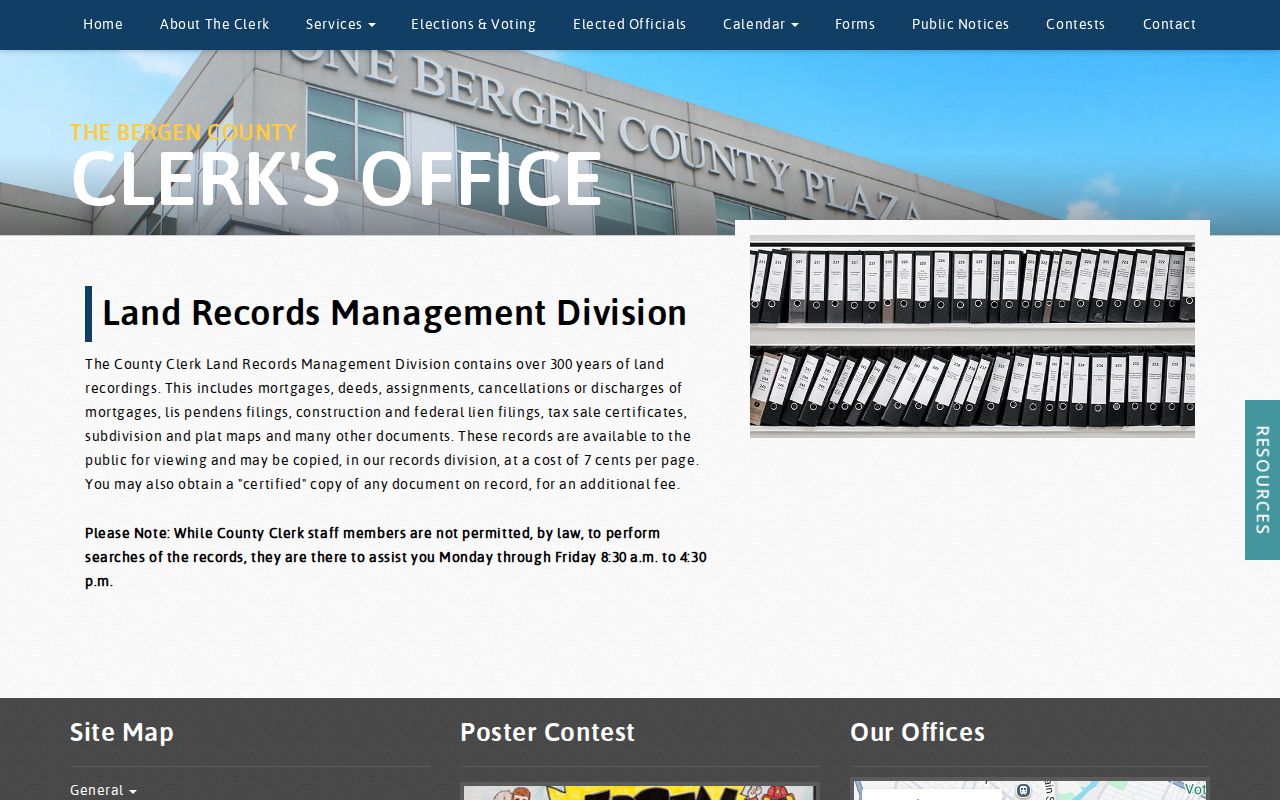
The online cutoff is an operational boundary, not the beginning of Bergen County land recording. The Clerk says it holds more than 300 years of land recordings, with older books and indexes available through the records division. A researcher working before 1970 should arrive with Fair Lawn or predecessor-town wording, a block and lot where known, a party name, a date range, and spelling variants. Staff cannot perform the search for the requester, but can explain the indexing system during weekday hours. Public records can be viewed and copied in the division for $0.07 per page; certified copies carry an additional fee.
The Bergen County Land Records Management page describes the records-division route for older records, public viewing, copies, and certified copies.
Write down the book and page or instrument number before requesting a copy. For a record held by another public office, direct a focused OPRA request to that office's custodian instead of asking the Clerk for a record it does not maintain.
Fair Lawn Previous Residents and Borough Names
Fair Lawn's dates and names are part of the address trail. The Borough was incorporated on March 6, 1924 from part of Saddle River Township as Fairlawn, and its spelling changed to Fair Lawn in 1933. A pre-1924 record may be filed under Saddle River Township. A record from 1924 through 1932 can use the one-word borough spelling. Test all three forms in a directory, newspaper, census, deed, or archive search before deciding that an address vanished.
Place names need the same restraint. Radburn can appear as a neighborhood, postal, or community label without becoming a separate municipality. A source near the borough boundary can be a regional lead rather than Fair Lawn proof. Preserve the original form, then verify the legal municipality through a parcel source or the relevant custodian. This simple comparison prevents a modern address label from overwriting an older source's geography.
Note: Store the printed street form, postal label, legal municipality, and block/lot in separate fields when source dates do not match.
Fair Lawn Previous Residents in Directory Years
The Ridgewood Public Library Heritage Center has Fair Lawn directory material from 1931 through 1973 on reference-area microfilm, plus a finding aid with individual-year and reel clues. A volume may have alphabetical entries and, depending on the edition, a numerical or reverse section. Those are valuable for tracing who was listed at a Fair Lawn address around a transfer. They do not establish title. Ask the library at heritagecenter@ridgewoodlibrary.org or (201) 670-5600 ext. 135 to confirm the year, format, and reader availability before travel, then request a scan or citation rather than a certification of residence.
- Choose directory years immediately before and after a recorded transfer or a known event date.
- Record the exact town heading, address spelling, page or reel, surname, business or occupation wording, and any vacant or removal notation.
- Pair the dated directory lead with the nearest available federal census year, keeping its enumeration geography separate from the later street label.
- Test a disappearance against a deed, later directory, newspaper item, probate file, or corrected address form before drawing a conclusion.
The Fair Lawn city directory page describes the collection access and how an entry is read. Here, its role is narrower: put a household lead beside the recorded property chronology and preserve uncertainty where a volume is absent.
Newspaper Windows for Fair Lawn Past Residents
Newspapers can put a person, event, or business at an address for a date. For an obituary, start around the death date, inspect the full page, then widen the search if needed. The Fair Lawn-Radburn News and successor titles support twentieth-century local research, with the sequence noted from 1938 through 1999. Search Fairlawn and Fair Lawn, omit punctuation in surnames, and test common OCR substitutions. A paid notice, staff item, church announcement, civic resolution, or advertisement carries a different weight.
Capture the exact publication title, issue, page, column, name wording, address, and notice type. A library or holding society, not municipal OPRA, is usually the route for a newspaper copy. Ask whether it can provide a scan under its copying policy. Compare the item with a directory, census, deed, assessment, probate file, cemetery source, or vital record. A news hit is a lead to corroborate, not a certified event record.
Sanborn Context for a Fair Lawn Address
The Library of Congress holds a Fair Lawn Sanborn set for 1948 through 1950 with 29 sheets and 30 images. It can place a structure in its street-block setting, showing building footprints, construction material, number of stories, hazards, and named uses where printed. It does not name private residents or prove present ownership. Use it after confirming the sheet number and street orientation, then compare the physical picture with a directory year or a recorded document.
The Bergen County Property Alert explanation describes matching alerts by legal description and party name.
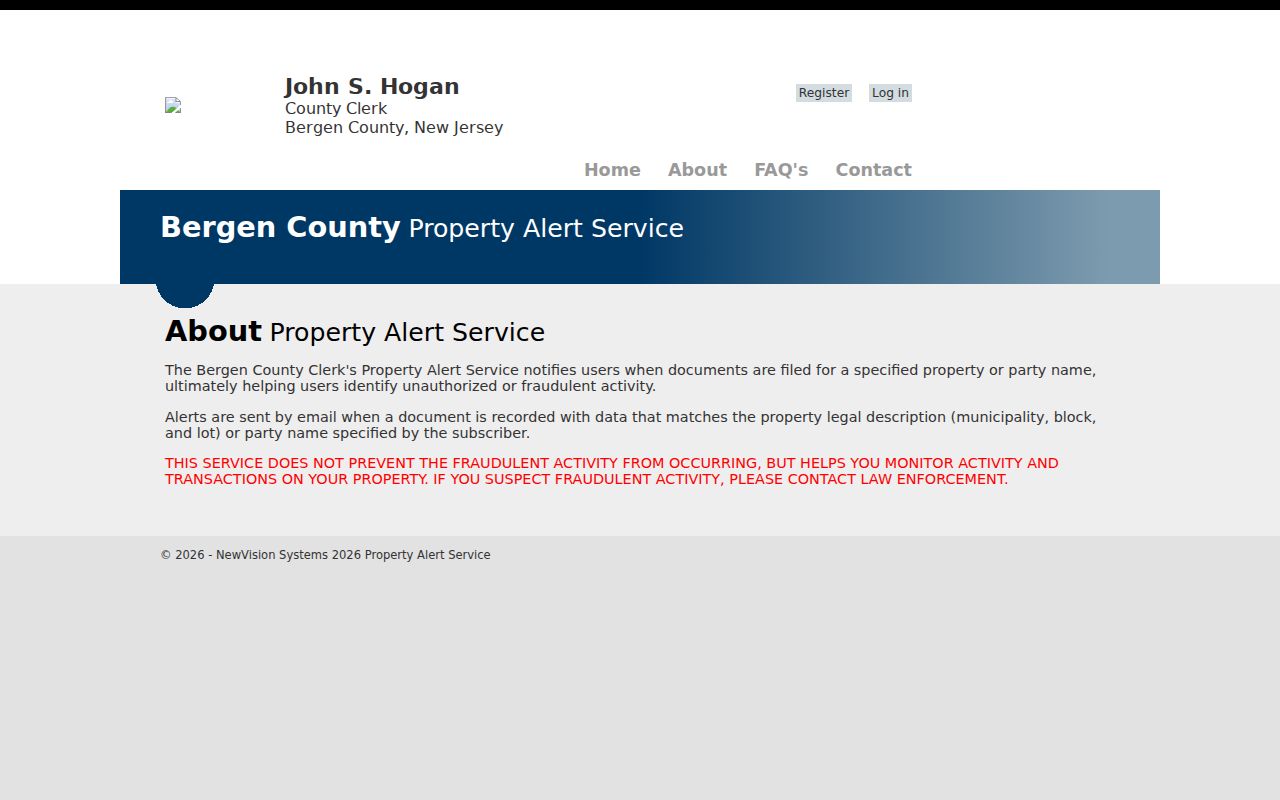
An alert is a current monitoring tool, not a substitute for a backward deed search. The stable legal description that supports its matching is also why it should be retained alongside an address history.
Fair Lawn Previous Residents, Census, and Probate
Owners are only one part of a house history. The federal census schedules available through 1950 can supply household, age, relationship, and enumeration context, although an older entry may use Saddle River Township, a ward, or an enumeration district rather than a later Fair Lawn street label. Use the census with a directory year, not as a replacement for it. A directory's listed occupant, a census household, and a recorded grantee may be different people with different relationships to the address.
When a deed chain reaches a deceased owner, the Bergen County Surrogate is the official route for probate information. An estate file may identify an executor, attorney, beneficiary, or heir and may contain address clues in petitions or supporting documents. The office explains that a will cannot be admitted until at least 10 days after death. Match the legal name and death date, then follow the office's copy procedure rather than assuming an online surname result is available.
Lawful use. Fair Lawn house-history research is for family history, property curiosity, and civic understanding. Do not use a record to track, harass, intimidate, or harm a living person.